
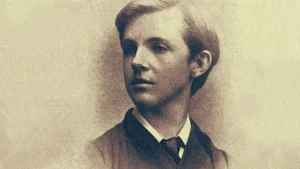
 Lionel Pigot Johnson (1867–1902) was born at Broadstairs in Kent, a slight figure — only two or three inches over five feet — frail, and with such a youthful appearance that he was said to look like a schoolboy throughout his adult life. Oscar Wilde reportedly joked about Johnson leaving the Café Royal “to hail the first passing perambulator.”
Privately educated before winning a scholarship to Winchester in 1880, Johnson left for New College, Oxford, where his tutor was Walter Pater — a formative influence. A doctor’s recommendation that alcohol might help his insomnia is said to have set in motion a lifetime of heavy drinking. His inability to sleep drove him to long nocturnal walks and all-night work sessions; daytime was for sleeping. It was during one of these Oxford afternoons, in February 1890, that Oscar Wilde visited the university, heard about the promising young poet, and came to call. Johnson was enchanted. He later wrote that Wilde “discourses with infinite flippancy of everyone: lauded the Dial: laughed at Pater: and consumed all my cigarettes. I am in love with him.”
It was at Oxford that Johnson was introduced to the Century Guild, and so impressed was he that, after graduating with a first in literae humaniores, he moved in with Horne and Mackmurdo at 20 Fitzroy Street — by that point one of the main artistic gathering-places in London, frequented by figures including Yeats, Shaw, Wilde, and Arnold Dolmetsch. On 22 June 1891, Johnson was received into the Roman Catholic faith at St Etheldreda’s in Ely Place. That same month, at Wilde’s house in Tite Street, he introduced his fellow Wykehamist and close friend Lord Alfred Douglas to their host — a fateful meeting, as it turned out, for everyone concerned.
Johnson’s own homosexuality was kept strictly repressed, though it surfaces in his most celebrated poem, The Dark Angel. Through the early 1890s he undertook a prodigious amount of journalistic work to pay off Oxford debts, and gradually made his name on the London literary scene. An early member of the Rhymers’ Club, he contributed to their poetry anthologies of 1892 and 1894. His first book of criticism, The Art of Thomas Hardy, appeared in 1894, and his poetic ambitions were fulfilled the following year when his Poems were published.
By 1895, however, his drinking had become unmanageable. Asked to leave 20 Fitzroy Street by Mackmurdo, he wrote a pleading letter requesting a stay of execution, promising to take the pledge and acknowledging, with characteristic lucidity, that while abstaining altogether was easy for him, moderation was not. He was unable to stay on the wagon. He moved to 7 Gray’s Inn Square in September 1895, increasingly isolated, continuing to write poetry — his second collection, Ireland, with Other Poems, appeared in 1897 — and reviewing for various publications, all the while drinking two pints of whisky a day.
He died on 4 October 1902, as a result of a cerebral haemorrhage, after falling from a bar stool at the Green Dragon in Fleet Street — probably following a stroke. He was found unconscious in the street by a policeman and taken to St Bartholomew’s Hospital. He is buried in Kensal Green Roman Catholic cemetery. W.B. Yeats, who had known him well and admired him greatly, remembered Johnson in the milieu of the 1890s as “always at my side,” calling him “our critic, and above all our theologian.”
He was 35 years old.